


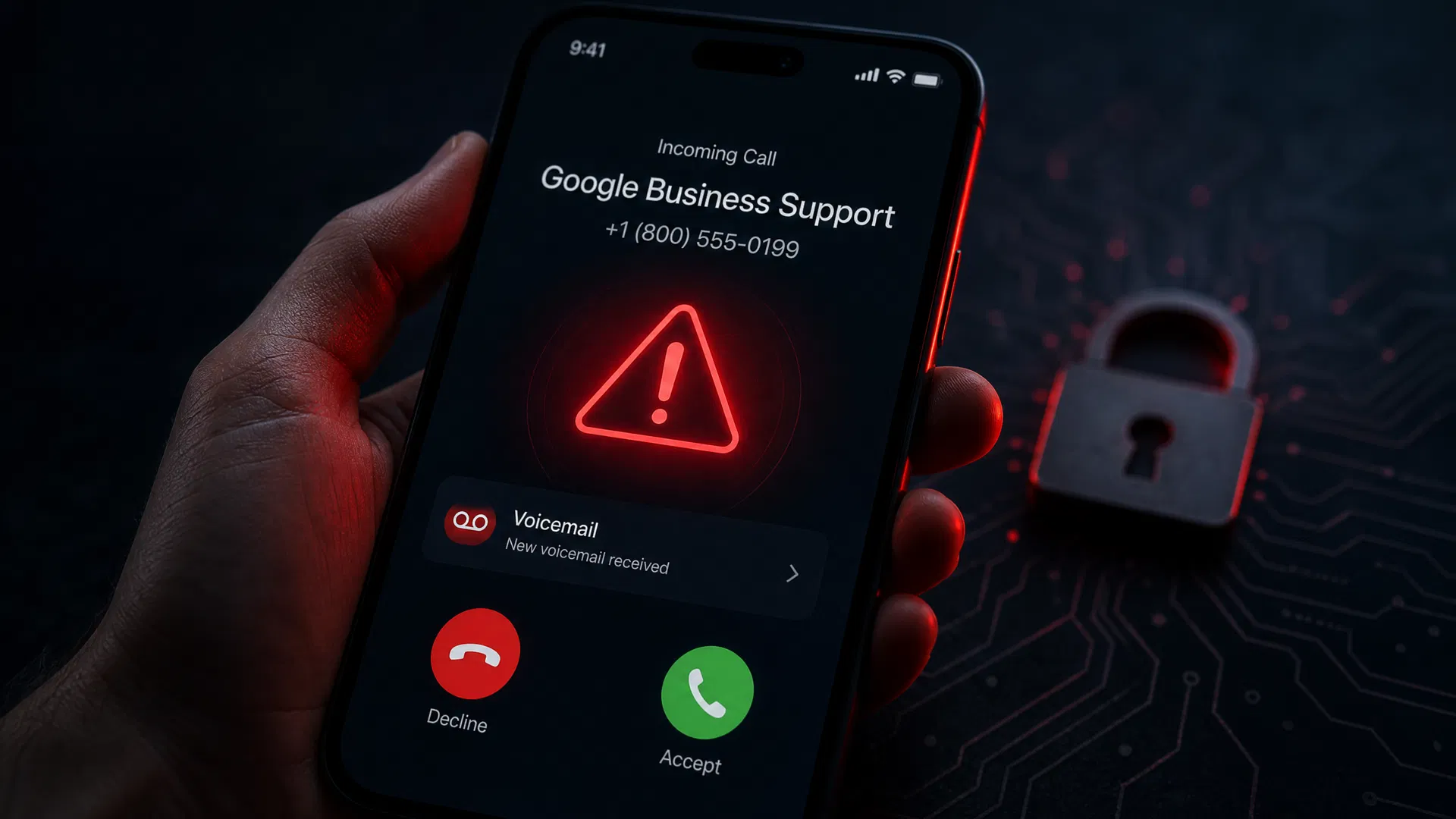
The call came in this afternoon from a 541 number I didn't recognize. Local area code, so I almost picked up. Figured it might be a jobsite or a referral. Let it ring through instead. A minute later the voicemail transcript landed on my screen.
Some guy named James, from the "Business Verification Department." My Google Business listing was under audit and flagged for review. Call back before 5 p.m. Eastern or customers in my area won't be able to find me anymore. He repeated an 877 number three times, thanked me, said talk soon.
I run an IT company, so I knew inside of two seconds it was garbage. But my first thought wasn't about me. It was about the framing crews and the storage operators and the guy running a two-truck plumbing outfit out of a shop off Pacific Boulevard. The people who don't spend their day thinking about this stuff. Because that call is built to scare exactly them.
What the voicemail actually said
Spoofed local 541 number. Caller: "James," from the "Business Verification Department." Claim: your Google Business listing is under audit and flagged for review. Deadline: call back before 5 p.m. Eastern or customers can't find you. Callback: a toll-free 877 number (different from the one that rang you), repeated three times.
Every tell in one message. Keep reading to see why each one matters.
Google does not call you about your listing
Start here, because it's the whole thing. Google has no "Business Verification Department" cold-calling small businesses. They don't phone you out of the blue to tell you your listing is in trouble. When Google actually needs to verify a business, it happens on your terms, from inside your Google Business Profile: a postcard to your address, an email, a video call you schedule, or a code you asked them to send. Never an unsolicited call, from a random number, with a callback line and a countdown clock.
So the moment a voice tells you to call some number back before a deadline to save your listing, you already have your answer. That is not Google. Nobody at Google works that way.
The tells, once you know what you're looking at
This voicemail hit every note these things always hit.
The number was spoofed. A 541 to look like somebody local, maybe a neighbor or a customer. The actual callback was a toll-free 877, a different number than the one that rang me. Real callers don't make you dial a different number than the one they called from.
There was a deadline. Five o'clock Eastern, which isn't even our time zone. Urgency is the point. They want you moving before you've had a second to think it through.
The authority was vague. "Business Verification Department" sounds official and means absolutely nothing. No company name, no case number that leads anywhere. Just an important-sounding label.
It pointed at a phone number instead of your account. Anything real with your listing happens when you log into your own Google Business Profile. It does not happen through a stranger on a phone tree.
What they're actually after
Two plays, usually.
Sometimes it's money. They get you on the line and sell you "verification," or "listing protection," or some monthly SEO service to fix a problem that was never real. You pay for nothing.
Sometimes it's worse. They walk you into reading them a verification code, or logging in on a page they control, and now they own your listing. Once they're in, they swap the phone number and the website on your profile. Your customers start calling them instead of you. For a trades business, where the phone ringing is the entire pipeline, that is not a small thing. That is your lead flow handed to a stranger.
What to actually do
The short version
- 1Don't call the number back. Hang up, delete the voicemail, move on.
- 2If it nags at you, log into your Google Business Profile the normal way. Type the address yourself, don't follow any link they gave you. If there were a real problem, that's where it would show. There won't be.
- 3Report the number as spam so your phone starts filtering the next one.
- 4Tell your crew and whoever answers your office phone. That's the part people skip.
The last step is the one that matters most. The call doesn't always land on the owner. It lands on the new office admin, or the apprentice covering the desk at lunch. The person most likely to panic and least likely to know Google doesn't operate this way. Two minutes warning them is cheaper than cleaning up a hijacked listing.
Why this keeps happening
It keeps happening because it's nearly free to try. Dial ten thousand businesses with a robocall, spoof a local number on each one, and you only need a handful of people to panic and call back. The whole model runs on volume and fear.
So don't be the handful. If a call ever makes you feel rushed and scared at the same time, sit with that for a second. That feeling is the product they're selling. Slow down. Check it yourself, through your own account, on your own time. Nobody legitimate is going to lose your business for you if you wait an hour to verify.
And if you're a client of mine and one of these ever lands in your voicemail, forward it to me before you do anything. Takes me thirty seconds to tell you it's junk. That's what I'm here for. If you want to talk through where your business stands on security more broadly, read our post on why a password manager comes before antivirus or check out our cybersecurity services for a full picture of what we cover.
Andrew Allen
Owner & Founder, Taggerung Solutions
Eight years in enterprise IT, seven-plus years in Oregon construction, including General Foreman at Dick Welker Construction. Holds an active Oregon CCB license (#252384). About Andrew →